SpaceX bought Cursor. The interesting part is what shipped after.
Build logBy Daniel Netzerfactoriesagentsagents-in-live-opsagentic-software-factory
SpaceX closed Cursor (Anysphere) on 2026-08-14. The operator story is what accelerated after close: Rollouts, Security Reviewer, Self-Hosted Machines, Origin — mapped onto a circular real SDLC.
Cursor covers Plan through Release in uneven depth. Operate and Learn stay open. Name the human gates; do not invent SpaceX intent.
At a glance
- Spine: SpaceX did acquire Anysphere (Cursor) — binding agreement mid-June, close 2026-08-14. Cursor's own words: join SpaceXAI, more GPU, cheaper capable models, Grok 4.6 as an early look. The operator story is what accelerated after close: production-path agents (Firetiger → Rollouts), Security Reviewer, Self-Hosted Machines, Origin — sitting on Automations + Cloud Agents that were already public. Map those to a circular real SDLC (Plan → Design → Build → Test/Review → Release → Operate → Learn). Open seats today: Operate and Learn. Name the human gates; do not invent SpaceX intent.
- Primaries: Cursor is now a part of SpaceX (2026-08-14); SpaceX model-training partnership (2026-04-21); CNBC acquisition agreement (2026-06-16); Firetiger (2026-08-13); Origin; Self-Hosted Machines (2026-09-02); Rollouts + Security Reviewer (2026-09-23); Automations / docs; Bugbot.
- Honesty locks: Ownership premise is accurate with nuances (Anysphere entity, Cursor brand, SpaceXAI home, all-stock ~$60B implied equity in press — Cursor blog does not lead with valuation). "Dark factory" = operator metaphor only. No invented metrics. No SoftBank. No "SpaceX wants X." Linear handoff = optional neighbor sentence, not a co-lede (queue+stations pack is HOLD separately). AI SRE = operator name for the Operate gap, not a Cursor product. Rollouts = change-window deploy watch, not 24/7 ops.
- Operator takeaway: Wire post-close Cursor as stations on the circle — Automations + webhooks, Cloud Agents (hosted or self-hosted), Bugbot / Security Review / Rollouts as last-mile bots — and write down who may merge, dismiss findings, and approve revert PRs. Treat Operate + Learn as open seats until product catches up.
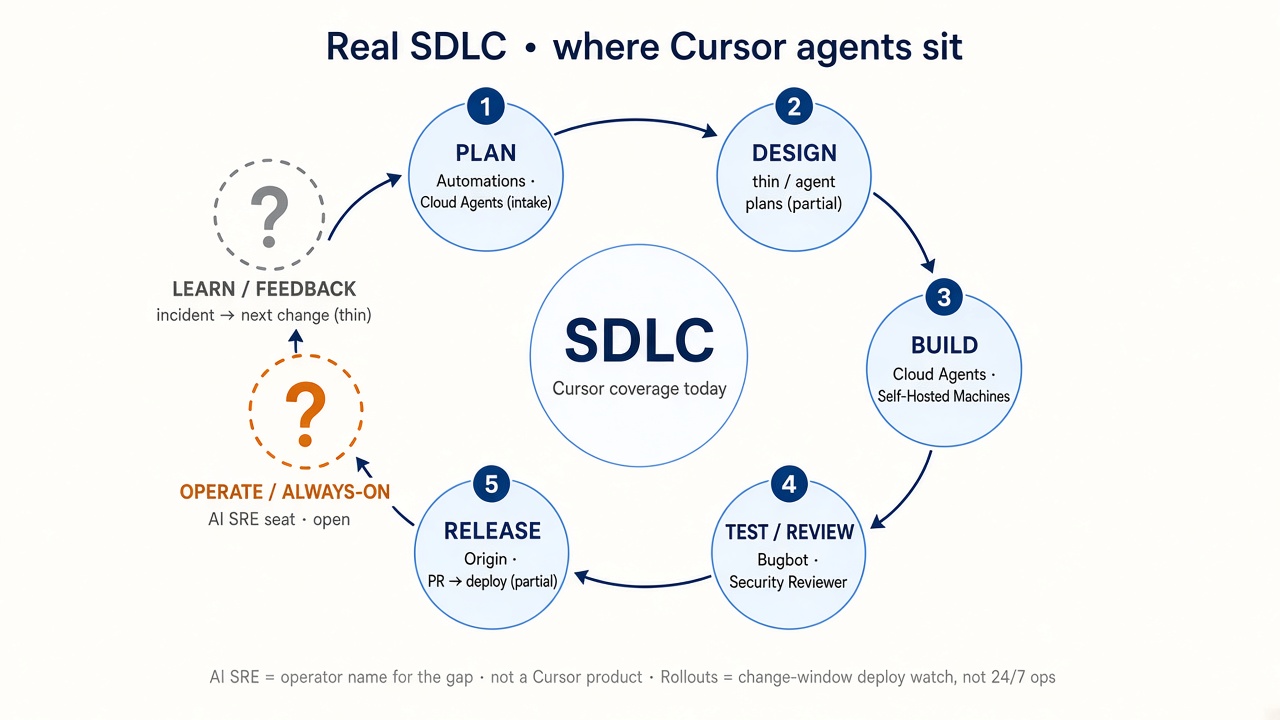
Figure: circular real SDLC (Plan → Design → Build → Test/Review → Release → Operate → Learn). Cursor covers Plan through Release in uneven depth. Operate (always-on / AI SRE seat) and Learn (incident → next change) stay open. Rollouts is change-window deploy watch, not 24/7 ops.
Ownership, plainly
On 2026-08-14, Cursor published Cursor is now a part of SpaceX. That closes a path that started in public on 2026-04-21 with a SpaceX model-training partnership (Composer training on SpaceXAI Colossus compute), then a 2026-06-16 binding agreement covered by CNBC as an all-stock deal at an implied ~$60 billion equity value for Anysphere.
Naming that holds up:
- Buyer: SpaceX. Cursor's close post says the team joins the SpaceXAI team (Grok Build, Grok Bot, Grok API, Cursor, and more). That matches the earlier 2026 consolidation of xAI into SpaceX's AI division — not a SoftBank purchase, and not "xAI alone bought Cursor" as a separate story.
- Seller / brand: Anysphere is the company; Cursor stays the product name and keeps its blog. The day before close, Cursor was still buying — Firetiger joins Cursor (2026-08-13).
- What Cursor said the deal is for: largest GPU fleet access; stronger models that are more economical to run; customers get more capable models at lower cost; Grok 4.6 as an early look. Familiar ambition: less time writing code, more time on harder problems.
What we do not know from primaries, and will not invent: exclusivity of model routing, how goodwill gets allocated, or a SpaceX product roadmap for Cursor beyond that framing.
So the premise — "SpaceX purchased them" — is right. This field note covers what operators can wire differently in the six weeks after close.
What was already true before Aug 14
A dark software factory, in this studio's language, is an orchestration loop with named human gates. Map it to the circular SDLC above — intake and plan, design, build, review/secure, release, operate, learn — not a one-way pipeline that ends at merge. Cursor was already assembling stations on that circle before the close:
- Cloud Agents with their own computers (Feb 24) — isolated VMs, PRs with demos, work from web / mobile / desktop / Slack / GitHub. The same post already pointed at self-driving codebases: agents that merge, manage rollouts, monitor production.
- Automations (Mar 5; docs) — always-on agents on schedule or events: GitHub/GitLab/Bitbucket, Slack, custom webhooks, Linear (issue created / status changed / end of cycle), Sentry, PagerDuty. Cloud sandbox, MCP, memory across runs, optional service-account identity for team billing.
- Bugbot as the "original automation" — PR review for bugs and quality; Autofix can spawn a Cloud Agent. Security teams forked that instinct into dedicated templates (Mar 16 security agents): Agentic Security Review, Vuln Hunter, Anybump, Invariant Sentinel.
- Durable long-running agent loops (Jun 2) — Temporal-backed runs, multi-day work, reliability notes. Useful context; skip Cursor's internal PR-share percentages unless you want them attributed as Cursor's own claim.
None of that required SpaceX. The close sat on top of a station stack that was already shipping.
What accelerated after close
Production path: Firetiger → Rollouts
2026-08-13 (eve of close): Firetiger's team joins Cursor to work the after-the-PR problem — monitor rollouts, catch regressions, investigate incidents, feed findings back to coding agents (blog). Same note points at Cursor Origin and upcoming Change Monitors. Treat this as the pre-close production-path hire, not something that only appeared after Aug 14.
2026-09-23: that path productizes as Rollouts and Security Reviewer (blog), available on Teams and Enterprise, enabled from the Automations tab.
Rollouts: connect source control, deploy system, and telemetry (Datadog / Grafana / Honeycomb / …). Before merge, it drafts a monitoring plan (risks, intended effects, instrumentation gaps) you can edit. After deploy, it compares to baseline. On regression: notify the author, pause a progressive rollout, or open a revert PR waiting for approval. Cursor's own honesty line: it does not merge or roll back alone today. That is still a change-window product on Release → early Operate — not 24/7 service ownership.
Security Reviewer: runs on PRs with whole-codebase context — injection, authn/authz gaps, secrets, unsafe deserialization / redirects, vulnerable dependency changes, insecure defaults. Severity, attack path, one-click fix. Quality and style stay with Bugbot; security gets its own bot. That split matches what Cursor's security team learned when general Bugbot was not enough for threat-model-tuned, CI-blocking review.
Execution: Self-Hosted Machines
2026-09-02: Self-Hosted Machines move tool execution into pools you manage. Inference and planning stay in Cursor cloud; workers open outbound HTTPS; Cursor does not dial into your network. Pools scale with demand, partner with sandbox providers (AWS Lambda, Cloudflare, Coder, Daytona, E2B, Modal, Namespace, Vercel, …), Linux + Mac computer use. Same agent surfaces: desktop, cursor.com, mobile, Slack, GitHub, Linear.
For operators: this is the enterprise gate that was missing for many "dark factory" dreams — agents next to private source control and internal services without pretending a Cursor-hosted VM is your VPC.
Repo gravity: Origin
Origin early beta on paid plans (mid-August window, days after close): Cursor-hosted repos, PRs, code browsing, two-way GitHub sync for mirrored repos (GitHub remains SoT when synced; Origin is SoT for native Origin repos). Agents live next to the code browser. Enterprise admins can opt out. Agent-native features "soon" — cite as Cursor's words, not a shipped promise list.
Graphite (Dec 2025) remains the earlier review/stacking acquisition; Origin is the hosting surface. Do not collapse them into one product in the lede.
Models: Grok as an early look, not a locked story
The close post ties Grok 4.6 to the compute partnership. That is a primary for "what they said changed." It is not a primary for "third-party models are gone." Until Cursor publishes a routing change, treat model choice as unchanged unless your own workspace settings say otherwise.
Same vs accelerated (one table)
| Layer | Mostly same | Accelerated / new after close |
|---|---|---|
| Brand / entity | Cursor name, blog, Anysphere legal | Part of SpaceX (Cursor's framing); SpaceXAI team home |
| Write stations | Cloud Agents, desktop agents | Self-Hosted Machines (Sep 2) |
| Always-on Automations | Automations, webhooks, MCP, memory | Last-mile bots on Automations tab (Sep 23) |
| Review | Bugbot (+ Autofix) | Productized Security Reviewer; Firetiger→Rollouts |
| Repo | GitHub (etc.) as default | Origin early beta |
| Models | Multi-model IDE habit | Grok 4.6 framed as joint compute payoff |
| Gates | Humans merge / approve | Explicit: revert PR for approval; monitoring plan edits |
How to wire it (studio learnings)
What we would actually connect — not vendor brochure copy:
| Move | Do this | Why |
|---|---|---|
| Start from Automations | One bot per job: Bugbot (quality), Security Reviewer (vulns), Rollouts (deploy watch), plus thin custom automations | Different failure modes; different CI blocks |
| Triggers before prompts | Prefer PR opened/pushed, webhook from your deploy system, PagerDuty, Slack channel — then write the prompt | Event → sandbox → verify is the Automations design |
| Custom webhooks | Save automation → get URL + API key; regenerate if you flip to service account | Internal CI and monitors become first-class triggers |
| Identity | Team automations: service account for shared bots; personal for experiments | Billing + auth blast radius |
| Self-host when the network is the product | Pools for private SCM / internal APIs; keep Cursor-hosted for low-sensitivity repos | Matches how serious orgs already split CI runners |
| Name the gates | Merge; Security dismiss; Rollouts revert approval; monitoring-plan edit; long-running plan approval if you use it | If you cannot name them, you have hopeful automation |
| Linear (optional neighbor) | Assign / @Cursor → Cloud Agent → PR; Automations on issue created / status changed / end of cycle | Queue lives elsewhere; Cursor stays the station. Deep queue design is a separate pack — do not re-lede it here. |
Onboarding pattern that holds up: prove in a manual Cloud Agent run → save as Automation → attach the narrowest trigger → run as service account → add Bugbot/Security/Rollouts before you widen write tools. Memories help recurring chores; treat them as untrusted if the trigger can be poisoned.
Thesis: circular SDLC — Operate and Learn still open
Put the post-close stack on a circle, not a linear "agent development lifecycle" pipeline that ends at ship:
Plan → Design → Build → Test/Review → Release → Operate → Learn → (back to Plan).
Cursor today (uneven depth): Automations + Cloud Agents on Plan/intake; thin agent plans on Design; Cloud Agents + Self-Hosted Machines on Build; Bugbot + Security Reviewer on Test/Review; Origin + PR→deploy (partial) on Release. Rollouts closed the deploy-watch gap on the Release → early Operate edge: plan on the PR, per-env health after ship, revert PR for approval. That remains a change-window product.
Firetiger's join note already gestured further — investigate incidents, feed findings back to coding agents, Change Monitors. The open seats on the circle are Operate (always-on / 24/7 service ownership) and Learn (incident → next change).
Leading guess (Daniel): fill Operate with always-on monitoring that behaves like an AI SRE (operator seat name for the gap — not a Cursor product name) — continuous production signal → triage → open investigation / draft fix / page a human, with the same named gates as today. Learn stays thin until that loop writes findings back into the next Plan/Build cycle.
Other missing pieces worth naming (honest gaps, not a roadmap claim):
| Gap | Why it still hurts after Rollouts |
|---|---|
| Operate / AI SRE seat | Deploy-window health ≠ 24/7 service ownership; incidents arrive off the PR timeline |
| Learn / feedback | Incident → coding agent → next change is gestured; closed loop is still thin |
| Remediation loop | Notify + revert PR is containment; "agent proposes fix, human merges" is still thin |
| Agent fleet ops | Cost, concurrency, tool blast radius, and poisoned-trigger hygiene for always-on Automations |
| Progressive delivery ownership | Pause/revert hooks exist; canary/percentage ownership as a first-class station is still emerging |
| Eval of the agents themselves | Bugbot/Security review code; who reviews that the automation fleet still does the job you meant? |
| Telemetry → agent trust boundary | Rollouts needs Datadog/Grafana/…; how much prod data an agent may see remains an org policy problem |
Always-on monitoring is the strongest public-adjacent bet for the Operate seat given Firetiger + Rollouts. That is Daniel's operator bet, not a claim that Cursor will ship "AI SRE" next.
What this is not
- Not a SoftBank story, and not "rumor — maybe xAI." Public close is SpaceX / SpaceXAI.
- Not a valuation essay. ~$60B implied equity is a press/SEC fact; Cursor's close post leads with compute and product.
- Not "SpaceX wants Cursor to replace GitHub / kill Anthropic / …" — no primary for that here.
- Not a Linear×Cursor partnership announce. Optional handoff only; composition pack is separate.
- Not "dark factory" as a Cursor product. Operator metaphor for a loop with named gates.
- Not invented adoption metrics or studio ARR claims.
- Not "AI SRE" as a Cursor product name. Operator label for the open Operate seat.
Sources (primaries first)
- Cursor is now a part of SpaceX — 2026-08-14
- Cursor partners with SpaceX on model training — 2026-04-21
- CNBC — SpaceX to acquire… Cursor for $60 billion — 2026-06-16
- Firetiger joins Cursor — 2026-08-13
- Origin Code Hosting
- Run cloud agents on machines you manage — 2026-09-02
- Bots for the last mile: Rollouts, Security Review — 2026-09-23
- Build agents that run automatically — 2026-03-05; Automations docs
- Securing our codebase with autonomous agents — 2026-03-16
- Cursor agents can now control their own computers — 2026-02-24
- Bugbot docs
- Graphite is joining Cursor — 2025-12-19
Related
- Same-day Sol and Opus — Opus at AA 58 is not your default — Route on effort × $/task × your harness via Gateway — not Tuesday's Index.
- Pace the frontier — and the agents you already shipped — Contracts, HITL, evals, and spend/send/mutate gates for agents already in live ops.